

Sometimes we ignore them. Stuff them down deep until they can’t fit and come exploding out. Sometimes we only share them with a small group of people. Sometimes we only write them down. In some cases people replace them with things or unhealthy habits. If you haven’t already guessed I’m talking about emotions. I view emotions like a friend who you are on a road trip with. They keep you company. Sometimes they help with the directions, helping you notice if you are going in your desired direction. There are some instances where people let their emotions drive the car. This is where we get into trouble. What would it be like if you let anxiety drive the car? I imagine it would be a long car ride, given anxiety is consistently looking for all the possible threats. What about anger? That could be dangerous, weaving in and out of traffic. Our emotions are not meant to be drivers, they are meant to be passengers. They have some good insight, provide good directions even, but they aren’t qualified to operate a motorized vehicle.
Emotions are not bad. I feel like I need to say that again, emotions are not bad. They do need to be managed. Why, you ask? Many situations throughout your day evoke an emotional response from you, some more than others. Emotions are signals that are telling us something about our environment or situation we are in. So what happens if we ignore or suppress out emotions? Nothing good. Ignoring emotional self-care can negatively impact your physical and mental health and in some cases result in the use of unhealthy coping mechanisms.
My previous post gave an overview of the different categories of self-care. Emotional self-care is engaging in activities that allow you to safely experience your full range of emotions. Giving yourself permission to experience and express your emotions in healthy and productive ways. And no, punching that annoying co-worker in the face is not emotional self-care. When it comes to emotions and expressing them a helpful quote comes to mind. I don’t remember where I heard it, but I adore it, “Your emotions are valid, your actions are limited.”
Below you will find a list of healthy and productive ways to practice emotional self-care. As I mentioned in my last post, The interesting part in engaging in self-care is many of these activities could fall into multiple categories. For example talking to a therapist could be emotional and psychological self-care.
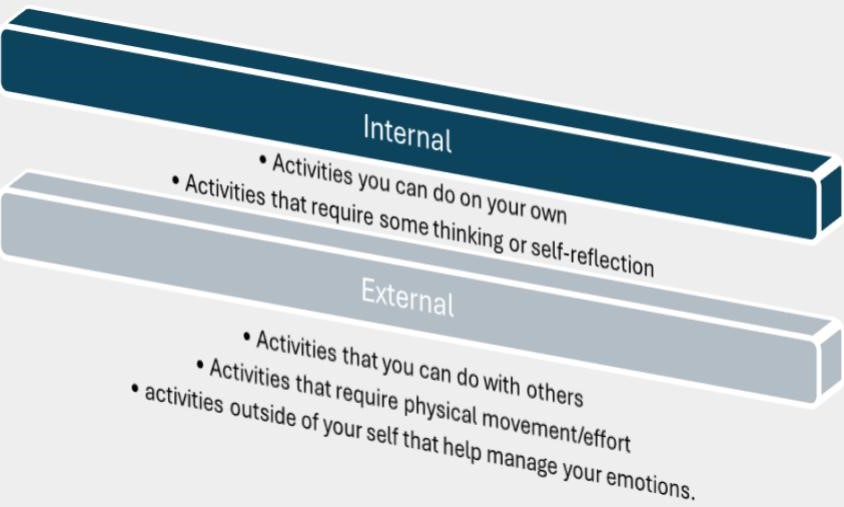
The chart below is a list of examples of ways to practice emotional self-care. It’s broken down into two categories:
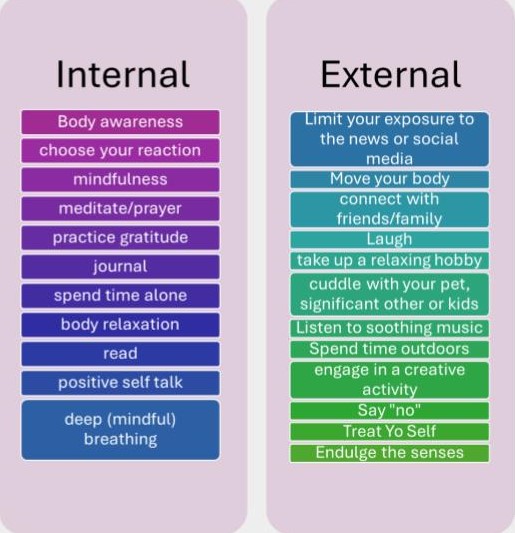
The next chart has a list of examples of the various internal activities you can use to help with emotional self-care. In looking at this list notice if anything sounds intriguing to you.
When choosing a self-care activity to incorporate into daily life, its best to start small. Choose one thing on this list and start off by doing it once a week. If that is enough for you great, keep it there. If you find you may need more perhaps your emotional self-care activity needs to happen each night before bed or when you wake up in the morning or maybe during your lunch break. Whatever you choose and whenever you choose to do it, your self-care activity should be something that replenishes you, so you are able to get back to your daily functioning and responsibilities.
I know you just read through this whole article. Your brain may be throbbing right now. So here are the main take aways, to carry with you:
- Emotions are not bad however, they need to be managed.
- Ignoring emotional self-care can negatively impact your physical and mental health and in some cases result in the use of unhealthy coping mechanisms.
- The definition of emotional self-care is allowing yourself to safely experience your full range of emotions. Giving yourself permission to experience and express your emotions in healthy and productive ways.
- “Your emotions are valid; your actions are limited.”
- When choosing a self-care activity to incorporate into daily life, its best to start small.
- Your self-care activity should be something that replenishes you, so you are able to get back to your daily functioning and responsibilities
I appreciate you taking the time to read this post, as I’m just trying to offer a few words of wisdom in a complex world. I hope you found it helpful or maybe you are already doing all of what I suggested, and it just feels good to feel affirmed. Life is hard and I am here to help. I offer individual therapy services to help you in your journey. If you would like to set up a time to chat my contact information is below.
Jennifer Bailey, LCSW & RDT
jbaileytherapyservices@gmail.com
Schedule a session with me through Grow Therapy

 jbaileytherapyservices@gmail.com
Leave a reply to The Importance of Parental Self-Care – jbaileytherapyservices@gmail.com Cancel reply