

It’s interesting how you can find some amazing life lessons in the most unexpected places. My favorite example of this is on an airplane. If you have ever flown before you may recall when the flight attendant is going over all the procedures if, by some chance, the plane goes down. Side note: I’ve never seen this done on a bus or train. Do they do this on cruises? Sorry, I got distracted. Anyway, the part of the flight attendant’s speech that gets me every time is (I’m paraphrasing) “In the case the oxygen masks are needed, make sure you put on your own oxygen mask before helping someone else put on theirs”. At first glance it could be easy to view this as selfish, putting yourself before someone else. Take a moment and think about the logic behind this instruction. How helpful can you be to the person sitting next to you if you don’t have oxygen yourself? Sometimes we have to put ourselves first in order to be able to help others. I have to put on my oxygen mask first, so that I can breathe and am conscious, to be able to help the people near me. What would happen if we took this approach and applied it to our daily lives? You look confused, let me explain. What would it look like if we took the time to reenergize? To rest when needed? If we took that sick day when we aren’t feeling well? What would it look like for us to engage in self-care effectively and productively?
At this point you may be rolling your eyes. I mean how many times have you read about the importance of self-care or work/life balance. A lot, I know. So what’s one more? Perhaps this time you will actually put on your oxygen mask? As you may know I’m a wife, mother and therapist, my life consists of caregiving. I care for the clients I work with, then turn around, go home, and care for my family. The definition of being a caregiver is in the name, you are giving care to others. If we don’t take the time to give to ourselves, or let others give care to us, it’s hard to be able to help and support others. This is not just a message for people in the mental health field, this is for everyone. In some way, shape or form, you give of yourself. You give your time at your job, you give your effort to a project, you give your love to your children or family. Whenever you give to others, it is imperative you also find the opportunity to give to yourself.
As I write this I worry that you will view me as selfish, that I am encouraging you to be selfish with me. I’m almost tempted to ditch this post and focus on another topic. But isn’t that what we do when we have the opportunity to do something for ourselves, we talk ourselves out of it? We convince ourselves that we don’t deserve to do that one thing for ourselves because we worry that we look self-centered? Helping others is a gift in itself, it allows use to connect with others, to feel a sense of purpose and pride. Helping others takes energy from you. If you keep giving and giving, helping and helping, it’s important to fill your cup back up or else at some point you will have nothing left to give. I want to add another word that should be paired with self-care, balance. Self-care should be viewed as something that we have to engage in, in order to find balance in life. In order for us to be able to give of our time, energy, thoughts, and feelings, we also have to balance that with opportunities to replenish. It’s a cycle, we give of ourselves and then we give to ourselves. Through finding this balance of giving to others and giving to ourselves, we can find stability in our physical health and mental health. You can’t be helpful to others or productive with the tasks you need to complete if you are unwell or overstressed. Just like you can’t help the person next to you with their oxygen mask when you have passed out due to lack of oxygen.
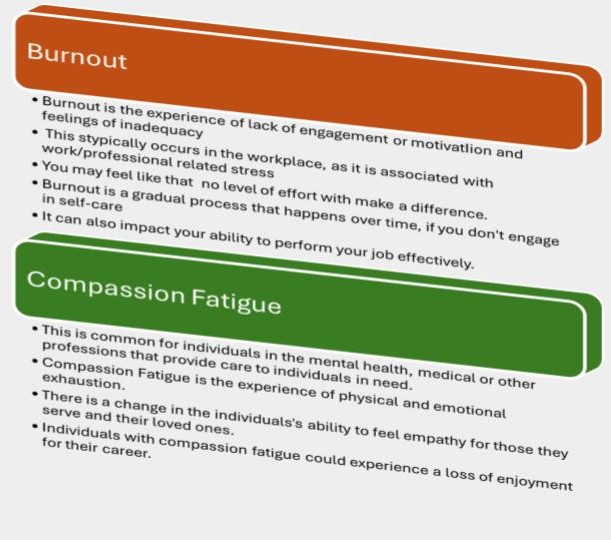
You may be at the point where you’ve heard or talked about self-care so much that skipping it doesn’t seem like a big deal. If we choose to skip out on self-care there can be significant consequences. If you are familiar with self-care, you may also be familiar with two other concepts burnout and compassion fatigue. For those of you who aren’t familiar with these terms, I’ll give you a quick overview:
Still not sold, alright, let’s try this. What if we shifted our perspective about self-care. Consider self-care as behaviors or actions that allow you to maintain or restore the physical, emotional, and psychological aspects of your life. Instead of viewing self-care as a moment of weakness, self-care is an action step to maintain your strength and energy.
So now that we have shifted our perspective of self-care, let’s take a look at the different types of self-care out there. Now if you were to google types of self-care you would find numerous examples. I am going to stick to some basics, largely because I don’t want to overwhelm you. And I don’t want to overwhelm you because by the end of this post. I would like you to choose one area of self-care to try out with the intention of it becoming a part of your regular routine:
Self-Care Categories
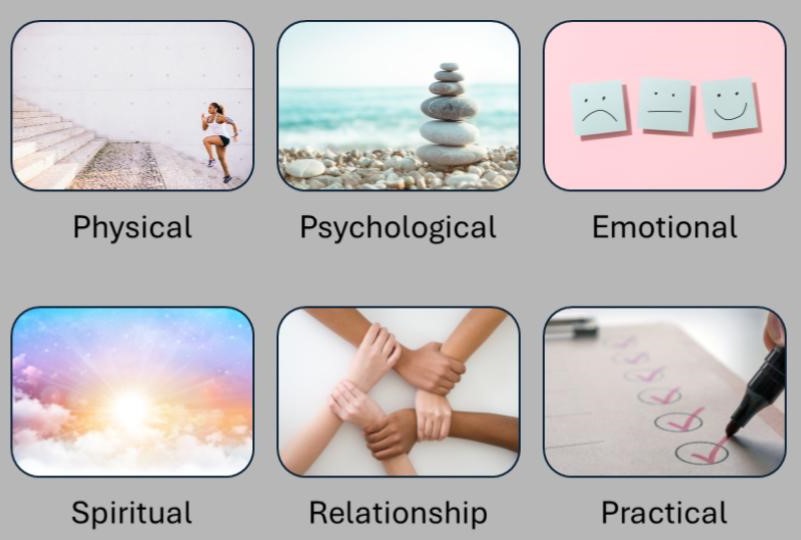
So now that we know these categories, lets define each one and look at some examples:
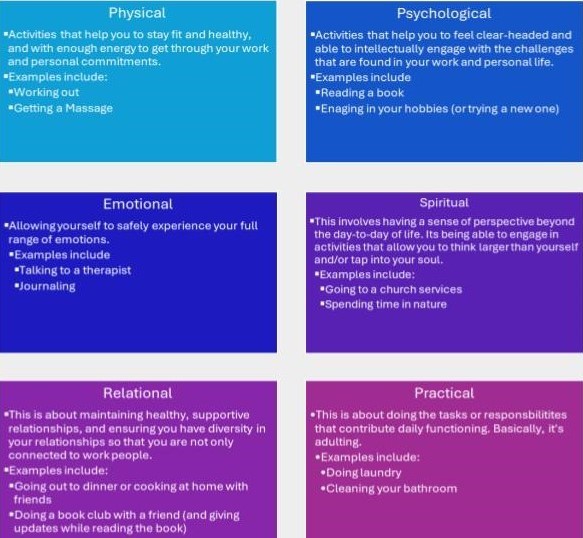
The interesting part of engaging in self-care is many of these activities could fall into multiple categories. For example going for a hike could be physical and spiritual. Doing a book club with your friend could be relational and psychological. If you’re interested in more examples in any particular category, sit tight, the next several posts, six to be exact, will be looking at each of these categories individually.
We have covered what self-care is and what happens when you don’t participate in self-care, let’s figure out how to incorporate self-care in your life. Earlier I mentioned that I want you to think about incorporating some self-care activities in your life. Before you start rolling your eyes or sighing dramatically, I want you to know we are going to go about this in a different way. Instead of giving a list of 17327650345738 things for you to incorporate in your already busy life, I want you think about your answers to these questions:
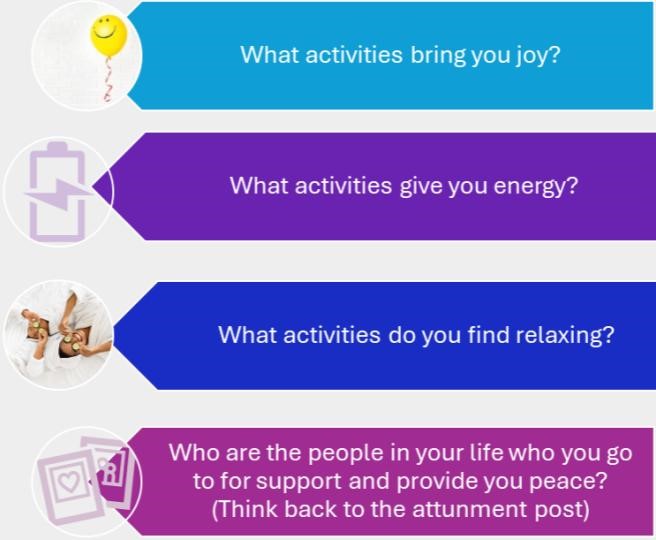
Once you have your answers I want you to go back to the self-care categories and see how your responses align with the descriptions. You may learn something about yourself. It’s important to remember that everyone’s form of self-care, the activities that allow us to recharge, is different. There is no one size fits all.
I know you just read through this whole article. Your brain may be throbbing right now. So here are the main take aways, to carry with you:
- Self-care is something that we have to engage in to help us create balance in life. In order for us to be able to give of our time, energy, thoughts, and feelings, we also have to balance that with finding opportunities to replenish.
- If we don’t participate in self-care we run the risk of burnout (can impact work performance) and compassion fatigue (can impact our ability demonstrate empathy).
- We explored 6 forms of self-care (more to come on these in the future):
- Physical
- Psychological
- Emotional
- Spiritual
- Relationships
- Practical
- My intention with doing a self-care series of posts is to help you incorporate self-care activities in your life and we are on step one, recognizing what type of self-care we need currently (use the questions above, to ask yourself and identifying which ones align best with which self-care category).
I appreciate you taking the time to read this post, as I’m just trying to offer a few words of wisdom in a complex world. I hope you found it helpful or maybe you are already doing all of what I suggested, and it just feels good to feel affirmed. Life is hard and I am here to help. I offer individual therapy to help you in your journey. If you would like to set up a time to chat my contact information is below.
Jennifer Bailey, LCSW & RDT
jbaileytherapyservices@gmail.com
Schedule a session with me through Grow Therapy

 jbaileytherapyservices@gmail.com
Leave a reply to Something larger than myself: Spiritual self-care – jbaileytherapyservices@gmail.com Cancel reply