
As you have come to learn I tend to ask a lot of questions. I have another one for you. When it comes to Oreos do you prefer to dip them in milk or eat them without milk. Me personally, I like to eat them without milk. In 2009 there was a very interesting Oreo Commercial. Take a look!
In the commercial 2 boys, I am assuming they are brothers, are at their kitchen table with a pack of Oreos in front of them. The older brother has a glass of milk beside him while the younger brother has a sippy cup. You see the older brother enjoying his cookies and dipping them easily in his glass of milk. Now if you know anything about sippy cups, their whole existence is meant to keep the beverage inside the cup. So, the younger brother wants to dip his cookies in milk as well, which proves to be a challenge. You see the younger brother tries hard to take the top off his sippy cup in various ways. At one point you see him trying to use his brother’s glass of milk to dip his cookie, which the brother lovingly denies. Then comes the twist, the younger brother problem solves this challenge by pouring milk, from his sippy cup, onto the cookie instead of dipping the cookie in milk. Clever kid.
This commercial demonstrates something we all want for our children and no I’m not talking about cookies. I am talking about thinking flexibly. I have mentioned previously how we want our children to be able to think, perspective take and have a growth mindset. We want to help our kids to do this in order to help facilitate their growth and their development into adulthood. We also want our children to be flexible thinkers. So today we are going over two concepts flexible and stuck thinking.
Flexible thinking is being able to shift and adjust to what is happening around you. Flexible thinking involves being able to hold different aspects in mind including:
- Other people’s agendas
- The surrounding environment
- Managing the unexpected
- Shifting from one task to another
- Participating in perspective taking
- Managing your emotions
- Getting along with others
- Trying different plans or tools to solve the same problem
- Being able to do group work
Stuck thinking means only having one view of seeing a problem or having only one way of doing a task. It’s like trying to make a square peg fit in a round hole which could result in emotional dysregulation. Stuck thinking is your child’s inability to take in the information from the environment and recall, that information to implement an alternative tool or strategy. Children tend to want one tool that fixes all their problems in that moment because it’s easier and doesn’t require as much thinking. Stuck thinking means we are unable change what we are doing or thinking about when the situation calls us to shift in some way. For example, when your flight is cancelled. Stuck thinking would be you not figuring out a new flight. There is an accident on the highway, and you choose to stay that route instead of finding a new route. Or you broke your arm, and you still try to get dressed as if you have two functioning arms. If you don’t find a new flight you aren’t getting to your destination. If you don’t find an alternate route you will be sitting in traffic for hours. If you don’t find a new strategy to get dressed with one good arm, well you may be going out into the world in your underwear. The bottom line is sometimes we need to come up with a new plan because the original one is no longer viable. Below is a chart of what stuck thinking looks like and what flexible thinking looks like.
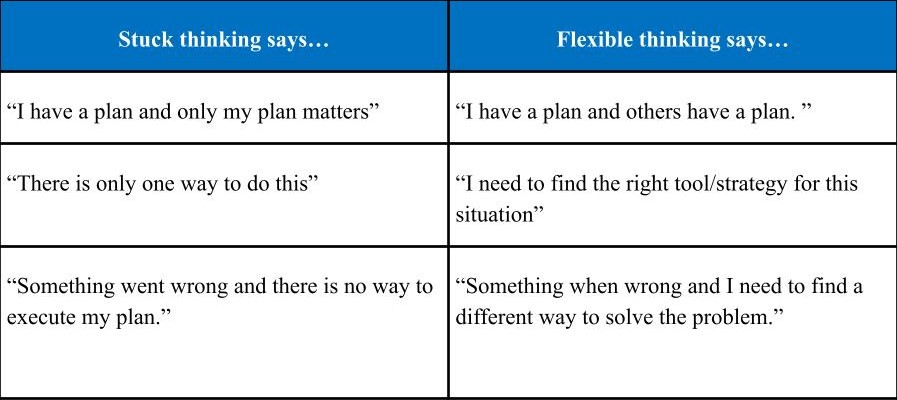
Let’s remember our children’s frontal lobes, the logical part of the brain, isn’t fully developed. So, it’s important to know that flexible thinking is a skill to be practiced, it doesn’t just happen. It’s easy for a young brain to get stuck.
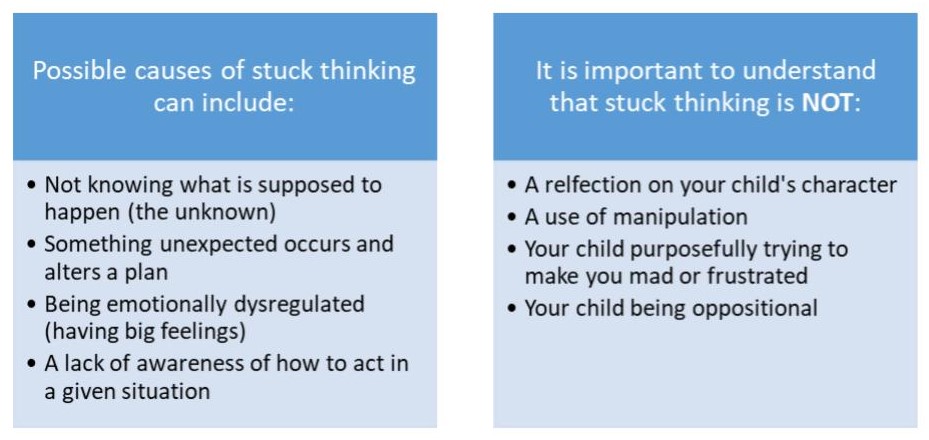
If we view our child’s stuck thinking in these ways, it will not be helpful in the moment, it will be harder for you to help your child work through their stuck thinking. Remember the attunement post, Harmonize with your Child? You need to manage your own emotions first. This doesn’t mean you can’t feel frustrated, annoyed, or disappointed. You do, however, need to manage your emotions and thoughts. We manage our own feelings so we can better help our children learn to manage their own.
We need to view stuck thinking as an underdeveloped skill that:
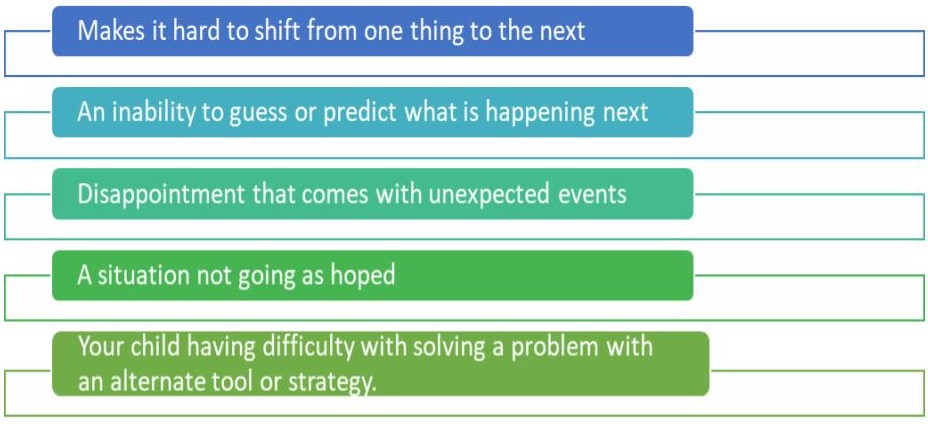
There are many strategies we can use for flexile thinking throughout the day that we use naturally. Your child needs to be taught each of these over and over again until they become habit.
Here are some ways to practice flexible thinking:
- Create the plan ahead of time. This helps with knowing what to expect; you can use the plan in those moments of rigidity, “Well what was the plan we talked about”. Making a plan A and plan B (and sometimes plan C) can be a useful tool. Building the flexibility muscle comes in because plans can change so preparing your child for the unexpected is important. This means we are discussing what things could go wrong, what emotions we could experience, and what things could go right. This can structure your child’s brain to engage in flexible thinking if and when the situation calls for it.
- Use strategies that help your child stay emotionally regulated. You won’t be able to review all of the possible unexpected situations, but you can plan for how we react to the unexpected. This is important because if your child is feeling big feelings, they can’t access their rational brain. We want to be able to notice when our child(ren) is getting overwhelmed, frustrated, or sad and help them manage these feelings. This looks like if we get upset or mad, we are going to pause and take deep breaths or we are going to take a break for a few minutes.
- Help your child notice the problem and talk through the possible solutions. This is something we do alongside our child(ren) as these can be opportunities to teach and practice how to think through problems, remember the post on metacognition?
- Preloading. This is preparing for what is to come and imagining how the situation is supposed to go or what to expect. An example could be when it is time to shift from an activity, discuss with your child as to what that would look like: “I know you like playing Legos, in 5 minutes we are going to start getting ready for bed.” Come back in 3 minutes. “In two minutes, I need you to start putting your Legos away.” Come back after 3 minutes is up. “You should be putting your Legos away; now can you go put on your pajamas and brush your teeth.”
- Practice flexible thinking. You can practice flexible thinking with events, tasks or situations that aren’t emotionally stimulating such as going a different route home from the grocery store or sitting in a different seat at the table or in the car, trying to eat your pizza crust first.
Helping your child develop their ability to think flexibly allows them to build skills in problem solving, perspective taking and working productively with others. They will also be able to better manage when something unexpected occurs, which is a good skill to have given life is consistently through unexpected things at us. As I mentioned earlier our children’s brains are still developing, they are going to get stuck, however we can help them shift when we, the parents, slow down. In those moments where your child is engaging in stuck thinking, we want to ask how they are feeling or what they are thinking. This would be a good time for a metacognitive question. Don’t know what I’m referring to? Check out this post, To think or not to think, that is the question, its about metacognition (thinking about your thinking). When your child is engaging in stuck thinking, they aren’t doing this to you, there is no malicious intent. Your child is just experiencing a moment where they don’t have enough information to move forward. That is when we step in and help our children get unstuck.
I know you just read through this whole article. Your brain may be throbbing right now. So here are the main take aways, to carry with you and incorporate when with you child:
- Flexible thinking is being able to shift and adjust to what is happening in your environment.
- Stuck thinking means only having one view of seeing a problem, only one way of doing a task.
- Causes of stuck thinking can include:
- Not knowing what is supposed to happen (the unknown)
- Something unexpected occurs and alters/ruins a plan/event.
- Being emotional dysregulated
- A lack of awareness of how to act/behave in a given situation.
- Stuck thinking is not:
- A reflection on your child’s character
- A use of manipulation
- Your child purposefully trying to make you mad/annoyed/frustrated.
- Your child being oppositional.
- our children’s brains are still developing, they are going to get stuck, however we can help them shift when we, the parents, slow down. In those moments where your child is engaging in stuck thinking, we want to ask how they are feeling or what they are thinking.
I appreciate you taking the time to read this post, as I’m just trying to offer a few words of wisdom in a complex world. I hope you found it helpful or maybe you are already doing all of what I suggested, and it just feels good to feel affirmed. Parenting is hard and I am here to help. I offer parenting support services to help you in this journey called parenthood. If you would like to set up a time to chat my contact information is below.
Jennifer Bailey, LCSW & RDT
jbaileytherapyservices@gmail.com
Schedule a session with me through Grow Therapy

 jbaileytherapyservices@gmail.com
Leave a reply to Resource Review: Good Inside – jbaileytherapyservices@gmail.com Cancel reply