
Raise your hand if you have ever said any of the following:
- Think before you speak.
- Think before you act.
- Think through the problem, to get the best solution.
- What were you thinking?
- Did you think about the consequences?
- Think about where you last saw your (insert item here).
*My hand is also raised*. As parents we want to guide and help our children so they grow into capable adults. But Jennifer Bailey, what makes a capable adult? I’m so glad you asked. Although there are many responses to this question, I am focusing on only one: thinking. A capable adult does not have all the answers, nor do they know how to do all the things. Capable adults know how to think through a situation. Capable adults know when to ask for help. They figure out who to go to for help. A capable adult thinks about the problem at hand and makes a plan to obtain a solution. Capable adults also are able to look at a problem that wasn’t effectively solved and think through what they could have done differently.
Today, I’m going to teach you a new word, metacognition. Metacognition is a developing awareness and understanding of all there is to think about at any given time. I know, that sounds very overwhelming. Here’s an example, you walk into a room full of people and instantly assess what the group is doing. Let’s say you notice there is music and a table filled with snacks and drinks. So, you would conclude you are at a party. Now if you see people standing around looking bored, you may conclude it’s a boring party. If you see people dancing, talking, and enjoying themselves, you make be more likely to stay at that party and join in on the fun. In that moment you are thinking about the group as a whole, the individual people as well as how you plan to respond to the situation. Your plan could be to head over to the snack table or hit the dance floor. Or, if the party is boring, you may sneak out to head back home and watch reruns of The Office!
We use metacognition in more instances than just whether we want to stay or leave a party. Metacognition, if we break it down, is thinking about our own thinking. It helps us navigate social situations, solve problems, and builds our sense of self. Think about it (Ha! See what I did there), if you have a solid understanding of how you think, you know how you may respond in certain situations. If we are able to engage in metacognition that means we are setting ourselves up to make positive and productive choices for ourselves.
I know what you are thinking. So now that I have a newfound understanding of metacognition how do I help my kid learn how to do it? Great question! The answer is…questions. Metacognitive questions to be exact. These are questions that help your child build skills in thinking about their own thinking. When your child practices metacognition they are building skills in their ability to think through problems, identify possible solutions and choose one that best fits the given situation.
We want to use metacognitive questions whenever we can, mainly because if you want to get good at something, you have to practice. A wonderful way to practice metacognitive questions is when there is a task to complete, a problem to solve or if an unexpected event happens. For example, perhaps you and your child are about to clean their room.
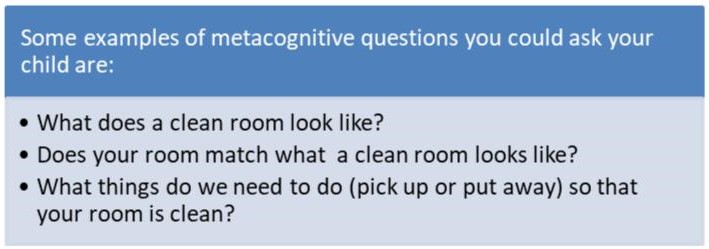
Now, the hard part in using metacognitive questions is allowing your child to attempt to answer these questions on their own. This will require patience from you, the parent. Remember, your child’s brain is still developing especially the logic part of their brain, the frontal lobe. In fact, the frontal lobe isn’t fully developed until at least 25 years old. So, when your 7-year-old, 12-year-old or even your 16-year-old is having a hard time knowing where to start or how to complete a task, remember that thinking (or logic) is an emerging skill at these ages, one that needs consistent practice over a long period of time. We are talking years folks!
Here are some more examples of metacognitive questions:
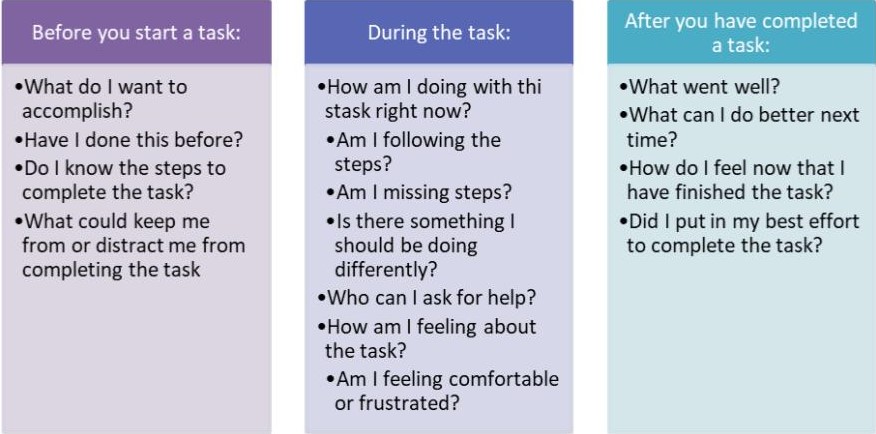
When using metacognitive questions, it’s not a fast-paced process. Just like thinking takes practice, it also takes time. Which is why I stated earlier that you will need to tap into your patience. So, if you are wanting to practice building the skill of metacognition with your child, start when you are not in a rush to be somewhere or get something done. The more you practice, the easier it will become and soon you may notice your child starting to engage in metacognition with less guidance from you.
I know you just read through this whole article. Your brain may be throbbing right now. So here are the main take aways, to carry with you and incorporate when with you child:
- Metacognition is thinking about your own thinking. It is adevelopingawareness and understanding of all there is to think about at any given time. (Think of the Party example)
- Teaching our children to think will help our kids develop into capable adults.
- Use metacognitive questions to help you teach your child how to think.
I appreciate you taking the time to read this post, as I’m just trying to offer a few words of wisdom in a complex world. I hope you found it helpful or maybe you are already doing all of what I suggested, and it just feels good to feel affirmed. Parenting is hard and I am here to help. I offer parenting support services to help you in this journey called parenthood. If you would like to set up a time to chat my contact information is below.
Jennifer Bailey, LCSW & RDT
jbaileytherapyservices@gmail.com

 jbaileytherapyservices@gmail.com
Leave a reply to Cookies & Milk – jbaileytherapyservices@gmail.com Cancel reply