
I want you to think of a person whom you have a very close bond. You know, the person who you want to call when you first hear good news or when you get bad news. Think of the person who brings you peace when you think of that relationship. When that person walks in the room it’s like a sigh of relief because “your person” has arrived. Now that you have a person in mind, I want you to take a moment and think about the specific things that person does that allows you to feel connected to them. Do they listen to you whole heartedly, do they make you laugh when you are feeling bad? Does this person genuinely want to know how your day is going? That person, that relationship, that I’ve had you think about has a specific component that is necessary in all relationships, attunement.
Attunement can be thought of as interpersonal harmonization. It is a level of understanding of another person whether it be physical, emotional, or cognitive means. Through this understanding, an individual can be aware of and manage their own physical, emotional, and cognitive reactions while complimenting and supporting those capacities in others. The person you thought of when I asked you to reflect on someone who you felt close to…yeah you are attune to that person.
Attunement is an important component when thinking about relationships. It’s the understanding of how another person functions and adjusting your actions in response. It’s not uncommon to mistake this for attachment. It is important to note the difference between attunement and attachment. Attachment is the response of or the descriptor of the relationship. Attachment can be based out of fear or stress, support or love. Whereas attunement is based on the understanding of the inner workings of another such as the non-verbal and verbal behaviors of another. Attunement is the establishment and connection of the relationship and requires constant learning, reciprocal response, a back and forth. Attachment is a result, where attunement is an intentional process. For example, two best friends who went to college together now live in separate states. They keep in touch via phone calls and text messages. And even though they don’t spend a lot of time together, when they are able to be in the same room it’s as if they were next door neighbors. That is attunement. The feeling of connection, that you could not speak to someone for a long period of time and when you do talk, it’s as if no time has passed at all. If we are able to effectively attune with each other, then typically the result is we can have a healthy attachment to one another.
Dr. Arredondo M.D., is a psychotherapist, neuropsychiatrist, and neuropsychopharmacology consultant for adults, adolescents, children, and families serving the San Francisco metropolitan area. He gives this definition for attunement: “Attunement refers to a deep, genuine, and significant connection with another human. The archetypical model is a mother/father with their infant. This relationship- one of the most remarkable found in all of nature- is the touch stone or gold standard to which attunement in circumstances is compared.”
Let’s take a look at the parent-child relationship and how attunement both effective and ineffective can play out in the following diagrams.
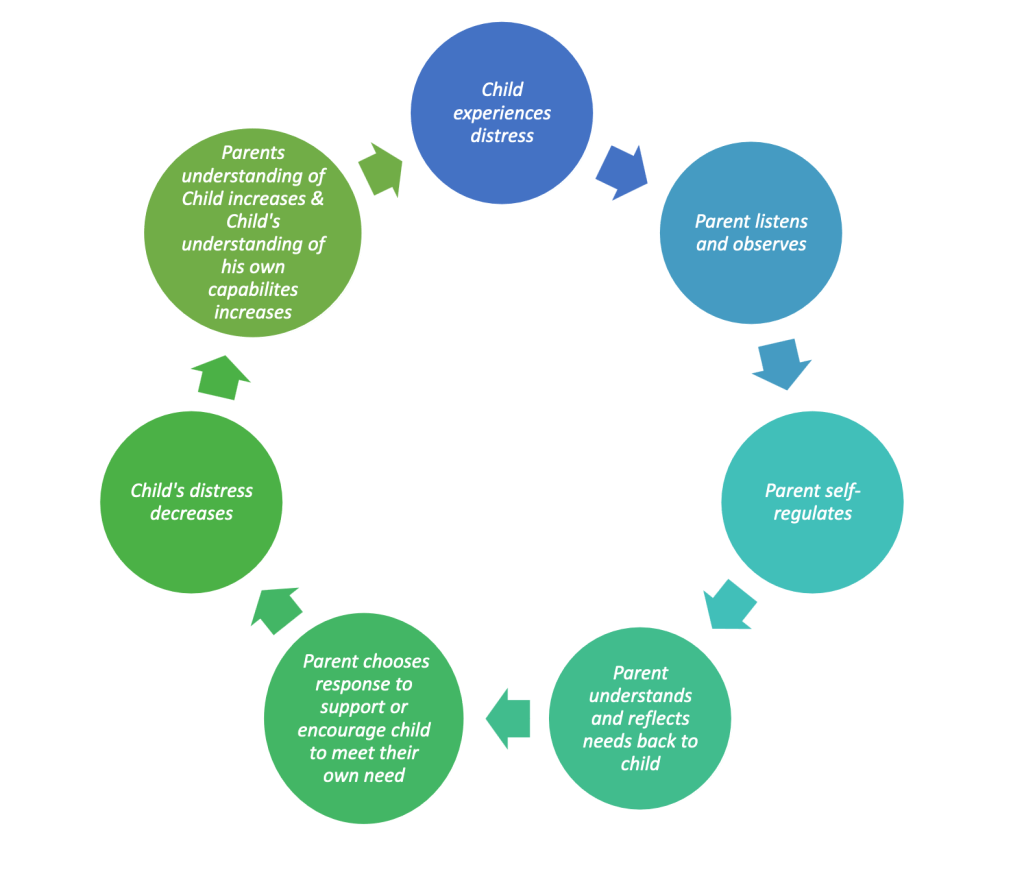
Effective attunement within a stressful situation with your child would look like this:
Ineffective attunement within a stressful situation with your child would look like this:
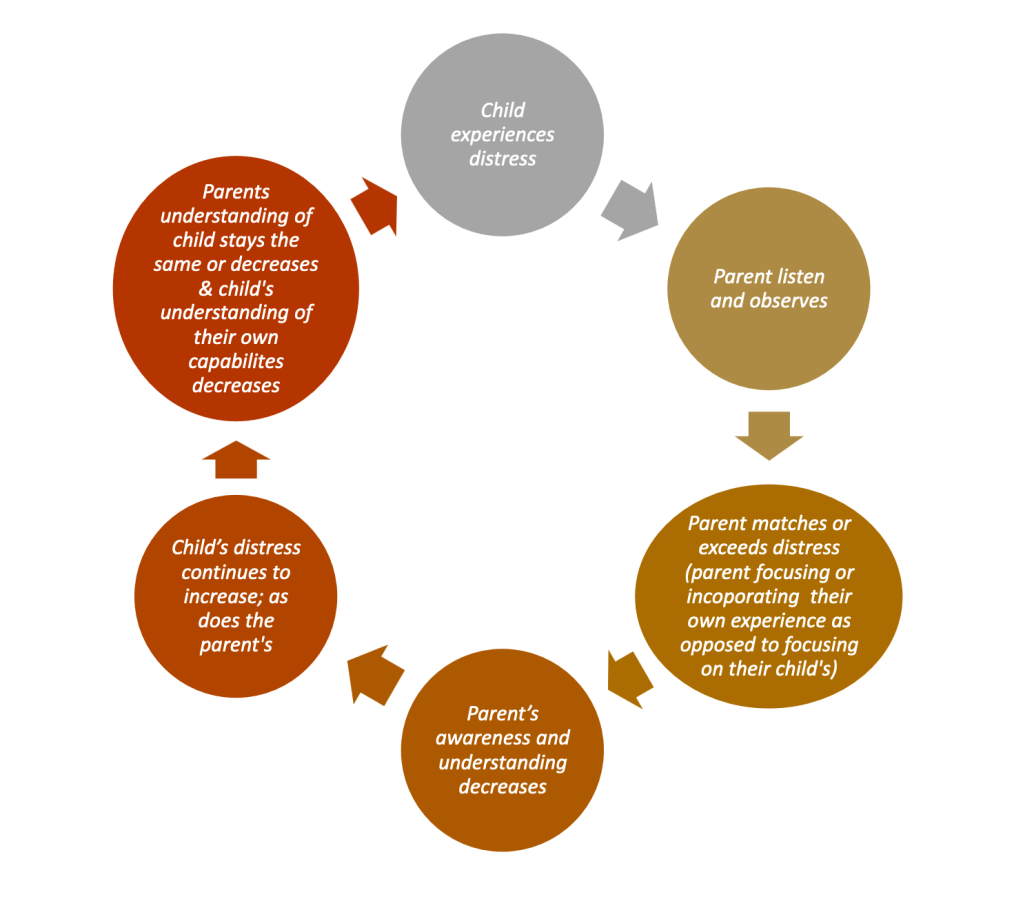
The two diagrams have similar components. In both scenarios the parent notices the distress of the child, however in the effective model of attunement, the parent is able to regulate themselves, prior to engaging with the distressed child. This is called co-regulation. This process consists of you helping your child learn to regulate themself (thoughts, feelings, and behaviors) by doing it alongside your child. Using the detailed knowledge you have of your child, you are developing a deeper understanding of them and consciously choosing your own emotions, words, and actions to support their regulation.
A lack of co-regulation is one of the barriers to effective attunement because without assessing your own emotional state, you may end up matching your child’s dysregulation causing further struggle with what may seem to be no way out, as demonstrated in the ineffective attunement diagram. Other barriers to effective attunement between parent and child include assuming your child should know how to attune and co-regulate with you already because you are their caregiver (“He/She should see that I am frustrated!”) or thinking attunement and co-regulation only occur when in conflict or crisis. Attuning and co-regulating happens whenever you are with your child, in times of calm and conflict; we are ALWAYS attuning and co-regulating.
Why do we need to attune and co-regulate? What does it accomplish? Deepening your attunement with the practice of co-regulation with your child will positively impact your attachment (relationship) with them. It will allow for clearer heads to prevail when faced with a conflict or problem, allowing for opportunities to resolve conflict and create solutions when you are with your child. In turn, your child will build upon their emotional regulation skills allowing them to effectively manage conflict with others, unexpected events, or other situational problems. When your child strengthens their theory of mind, metacognition, and ability to self-regulate they are more capable of problem-solving, being able to work with and understand others (forming and maintaining relationships) as well as deepening their attunement and attachment with you their parent.
Strengthening your attunement and co-regulation with your child involves being aware of their temperament, meaning are they anxious, overwhelmed, or calm? How can you tell? What can help? Another piece is spending time with your child to engineering rituals of togetherness. This could look like dedicated time during meals, car rides, bedtime routines, certain games, or family huddles. This time of just “being with” will strengthen your attunement. Use these times to model appropriate use of words and non-verbal actions in your communication through exemplifying self-regulation and talking about your experiences out loud, and when your child is discussing their experience, identify and validate their emotions with scripts such as, “That is frustrating. That is disappointing. You look confused. You seem excited”. An example of this would be, if Johnny (who is on the younger side think 5-7) is getting frustrated that his Lego pieces are not coming together, his parent may say “Oh man, that’s frustrating. Would you like some help?” or “You look frustrated, let’s work on this together.” or “How are you feeling right now? What could you do to help yourself?”
I know you just read through this whole article. Your brain may be throbbing right now. So here are the main take aways, to carry with you and incorporate when with you child:
- Attunement is the intentional learning and understanding of how another person functions.
- Attachment is the result or outcome of attunement.
- To effectively attune to your child (especially in times of distress) you have to regulate (mange) your emotions first before you try to help you child regulate themselves.
- To practice attuning spend time with your kid and just observe them. (playing Legos, running around outside when you are doing an activity together, etc.)
- Validate your child’s emotions.
I appreciate you taking the time to read this post, as I’m just trying to offer a few words of wisdom in a complex world. I hope you found it helpful or maybe you are already doing all of what I suggested, and it just feels good to feel affirmed. Parenting is hard and I am here to help. I offer parenting support services to help you in this journey called parenthood. If you would like to set up a time to chat my contact information is below.
Jennifer Bailey, LCSW & RDT
jbaileytherapyservices@gmail.com

 jbaileytherapyservices@gmail.com
Leave a comment